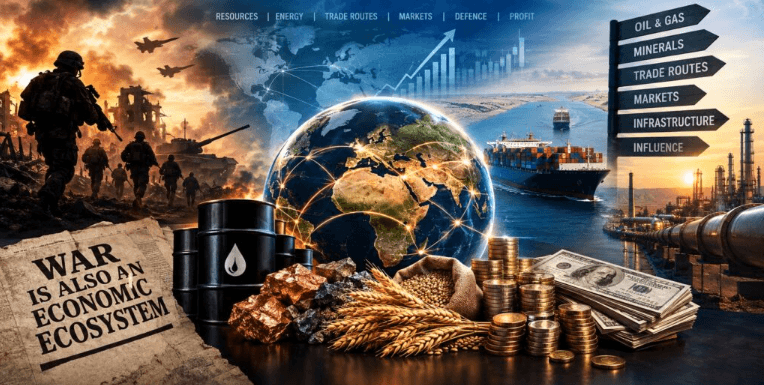
The global economy is increasingly shaped by geopolitical developments. From tensions in the Middle East to uncertainty over international energy supplies and trade negotiations between the United States and China, political decisions are exerting a growing influence on financial markets. As governments reassess their economic priorities and companies re-evaluate their international supply chains, investors are operating in an environment where geopolitical risk plays an ever greater role in financial decisions.
For several decades, globalization was mainly associated with economic efficiency, international cooperation and the growth of cross-border trade. Today, this model is undergoing a profound transformation.
Governments are now placing growing importance on strategic independence, energy security and control over key technologies. Companies are re-evaluating their international exposure, while investors increasingly need to factor political developments into their analysis of traditional economic indicators.
These changes are not limited to particular regions or sectors. They affect energy prices, currencies, commodities, industrial investment and international capital flows.
Six major trends illustrate how geopolitics is becoming one of the defining forces in global financial markets.
1. Geopolitical tensions make energy security a major concern for markets
The link between geopolitical stability and global energy markets has become increasingly clear.
The ongoing conflict in the Middle East shows how political and military developments can directly affect the availability, transport and cost of essential energy resources.
One of the main areas of concern is the Strait of Hormuz, a strategic maritime passage through which a significant share of the world’s traded oil and gas normally flows.
Recent attacks on commercial vessels have heightened uncertainty about maritime security. On November 5, Iran’s Revolutionary Guards reported incidents involving two oil tankers and a tugboat in the Strait of Hormuz. Meanwhile, maritime authorities have reported several incidents affecting commercial shipping in the region.
These events highlight the vulnerability of international energy transport networks.
Even when physical supply remains available, uncertainty over shipping routes, insurance costs and transport security can affect energy prices and business confidence.
For energy-importing economies, particularly those heavily dependent on international supplies, prolonged disruptions could raise production costs, intensify inflationary pressures and weaken economic activity.
What this means for investors: Energy markets are increasingly influenced by geopolitical developments, and not only by the traditional mechanisms of supply and demand. Oil, natural gas and related commodities can experience significant volatility when international shipping routes become uncertain. Understanding the link between geopolitical risk and energy security is therefore becoming essential.
2. Global energy security is accelerating the restructuring of strategic reserves and infrastructure
Recent geopolitical developments are prompting governments and energy companies to review their strategies for securing access to essential resources.
The traditional approach, based mainly on reliance on international supply networks, is now accompanied by greater attention to strategic reserves, alternative transport routes and regional energy infrastructure.
Disruptions to energy flows in the Middle East have exposed certain weaknesses in existing supply arrangements and underlined the importance of having sufficient reserves to absorb potential shocks.
According to information recently published by the Wall Street Journal, several major energy-importing countries are considering expanding their strategic storage capacity to better cope with future disruptions. Energy producers are also exploring various ways to bring their supplies closer to the main consumer markets.
This transformation goes well beyond the oil and gas sector.
Investments in storage facilities, transport infrastructure, power grids and alternative energy sources are increasingly tied to national economic security concerns.
Governments must also rethink the balance between affordability, environmental objectives and the need to maintain a reliable energy supply.
For Europe, these issues are particularly important. Energy security remains closely tied to industrial competitiveness, economic resilience and the continent’s ability to reduce its exposure to external disruptions.
What this means for investors: Energy infrastructure, utilities, storage, transport and alternative energy technologies could benefit from long-term structural investment. However, these sectors remain exposed to regulatory decisions, financing conditions and shifting government priorities.
3. The United States and China maintain a fragile trade truce
Relations between the United States and China remain one of the most important factors for the global economic outlook.
Both countries occupy a central position in industrial production, technology, agriculture and international trade. As a result, any change in their economic relationship can have repercussions well beyond their domestic markets.
On November 9, China announced a further extension of the suspension of certain trade measures targeting the United States, extending the existing trade truce by another two months.
The decision notably maintains the suspension of an additional 24% tariff on certain U.S. imports, while another 10% tariff remains in force. Several other trade-related measures have also been extended.
The announcement comes ahead of an expected meeting between U.S. President Donald Trump and Chinese President Xi Jinping at the upcoming APEC summit.
Although this extension reduces the immediate risk of further trade escalation, it does not resolve the deeper structural disagreements between the two economies.
Issues of industrial competitiveness, market access, technology restrictions and strategic economic interests remain at the heart of their relationship.
For international businesses, this situation represents both short-term relief and a source of longer-term uncertainty.
Companies operating in both markets must continue to anticipate possible changes in trading conditions, regulatory restrictions and additional costs related to their international activities.
What this means for investors: Developments in U.S.–China relations can influence global equity markets, currencies, industrial commodities and companies that depend heavily on international trade. Investors need to consider not only the immediate consequences of trade agreements, but also the long-term implications of evolving international economic relations.
4. Critical minerals are becoming strategic assets in international economic competition
The importance of critical minerals continues to grow as governments seek to secure the resources needed for modern industrial production and technological development.
Rare earths, lithium, graphite and other strategic materials are essential components of electric vehicles, batteries, renewable energy infrastructure, semiconductors and defense technologies.
China holds a particularly important position in several segments of these supply chains, creating strategic dependencies for countries seeking to develop their industrial and technological capabilities.
Recent developments illustrate how closely access to these resources is now tied to international trade negotiations.
On November 9, China extended until January 10, 2027 the suspension of certain export control measures on rare earths, as part of its broader efforts to preserve the framework of the trade agreement with the United States.
Although this decision brings some short-term relief to international supply chains, it also underscores the role of export policies and government decisions in the availability of strategic materials.
In Europe, North America and Asia, governments are increasingly exploring ways to diversify their sources of supply, develop domestic processing capacity and reduce their dependence on certain countries.
This process is expected to require significant investment in mining, refining, recycling and industrial infrastructure.
The strategic importance of these materials also means that their economic value cannot be assessed solely through the traditional mechanisms of supply and demand. Political relationships, export restrictions and national security priorities can all affect their availability.
What this means for investors: Critical minerals represent an increasingly important point of convergence between industrial development, technological innovation and geopolitical competition. Mining, materials processing, battery manufacturing and recycling could attract long-term investor interest, although regulatory, operational and commodity price risks remain significant.
5. European companies are rethinking their supply chains in the face of geopolitical uncertainty
Europe is also adapting to the changing structure of international trade.
For many years, companies prioritized efficiency and cost reduction by relying on highly integrated international supply chains. However, geopolitical uncertainty, trade restrictions and strategic dependencies are now prompting them to reconsider this approach.
A growing number of European companies are exploring ways to diversify their suppliers, develop regional production capacity and access new international markets.
A report published in September 2026 by the European Commission and the European Investment Bank highlighted this shift. It stresses that geopolitical risks are increasingly viewed as a structural feature of international trade, leading companies to adapt their sourcing strategies.
The report also identifies tariffs and regulatory requirements as growing obstacles to international business activity.
This development does not necessarily mean a retreat from globalization.
Instead, the international economy may be moving toward a more diversified model, in which companies seek to strike a balance between cost control, supply security and operational resilience.
For European industries, this transition could create opportunities in manufacturing, logistics, industrial technologies and infrastructure.
At the same time, restructuring supply chains may require considerable investment and lead, at least initially, to higher operating costs.
The challenge is therefore to develop business models that can remain competitive while becoming less vulnerable to disruptions in international trade.
What this means for investors: Companies active in logistics, industrial automation, production infrastructure and regional supply networks could benefit from these structural changes. Investors should, however, distinguish between companies with lasting competitive advantages and those facing rising costs without corresponding productivity gains.
6. Defense spending and strategic autonomy are becoming growing economic priorities
Geopolitical uncertainty is also changing governments’ budget priorities, particularly in Europe.
National security, defense capabilities and technological independence are taking up a growing place in government thinking, as governments reassess their exposure to international security risks.
The consequences extend well beyond the traditional defense sector.
Modern security needs increasingly involve advanced electronics, cybersecurity, artificial intelligence, satellite technologies, communications infrastructure and specialized industrial production.
At a meeting held on November 9, European finance ministers discussed the growing need for defense investment and the importance of stronger coordination among European countries.
The discussions notably highlighted the importance of joint procurement, technological research, industrial capacity and mobilizing private capital to support the development of European defense capabilities.
This development reflects a broader economic transformation, in which national security is increasingly closely linked to industrial policy and long-term investment planning.
However, higher military spending also poses a challenge for public finances. States must balance their new security commitments against their existing public debt, social spending and other economic priorities.
The resulting investment needs could affect a number of industrial sectors over an extended period.
What this means for investors: The defense, aerospace, cybersecurity, advanced manufacturing and strategic technology sectors could attract greater attention as governments strengthen their security capabilities. Investment decisions must nonetheless take into account political priorities, public budgets, regulatory requirements and company-specific risks.
How can investors navigate a financial environment increasingly shaped by geopolitics?
Geopolitical developments are no longer isolated events affecting only a limited number of industrial sectors.
They now influence the entire financial system through energy prices, international trade, commodity availability, public spending and international capital movements.
For investors, this environment makes understanding political and economic developments increasingly important.
The ability to assess different markets and to identify how international developments may affect financial assets is an important element of an informed investment approach.
Depending on their personal objectives and risk tolerance, investors may, for example, take an interest in different financial markets:
- Foreign exchange markets, where geopolitical developments can influence currency valuations.
- Energy and commodity markets, which are particularly sensitive to supply disruptions and international trade restrictions.
- Equity markets, where industrial competitiveness and government spending priorities can influence companies’ prospects.
- Indices and ETFs, which allow different forms of exposure to broad market movements.
Access to suitable trading tools can also influence how investors analyze markets and react to changing economic conditions.
Platforms such as Patria Invest provide access to a wide range of financial instruments, with the option of combining manual trading and automated trading solutions.
For clients who want additional human support, dedicated account managers can provide assistance with market analysis, trading education and risk management.
This combination of technology and human support reflects the growing diversity of approaches now available to individuals who wish to participate in financial markets.
Those wishing to explore the available services can find out more about Patria Invest.
Ultimately, the priority must remain making informed decisions, understanding the risks involved and adopting an approach consistent with one’s personal financial situation.
Conclusion: Geopolitics is becoming a defining force for the future of global markets
The relationship between geopolitics and financial markets is undergoing a profound transformation.
Energy security, international trade, access to critical minerals, industrial competitiveness and national defense are now increasingly closely intertwined.
Developments in the Middle East, U.S.–China relations and Europe’s strategic priorities show that political decisions can have consequences that reach well beyond national borders.
For investors, understanding these relationships is becoming an essential part of analyzing the global economic environment.
Traditional financial indicators remain fully relevant, but they must now be studied alongside geopolitical developments that may affect supply chains, commodity prices, corporate investment and international capital flows.
The coming years could bring further changes to the structure of global trade and international economic cooperation.
In an increasingly interconnected world, the ability to understand geopolitical developments and their financial repercussions could be an important advantage for investors looking to grasp the opportunities and risks of global markets.
Discover the financial markets and trading solutions offered by Patria Invest.
Risk Warning
This article is published for informational and educational purposes only. It does not constitute investment advice, a personalized recommendation, or an offer to buy or sell any financial instrument. Investing and trading involve risks, including the risk of losing all or part of the capital invested. CFDs, leveraged products and cryptocurrencies carry particularly high risks and may not be suitable for all investors. Past performance is not indicative of future results. The market analyses and outlooks presented are based on uncertain scenarios and in no way constitute a guarantee of future results. Automated trading does not eliminate the risks associated with financial investments. Before making any investment decision, each investor should consider their financial situation, investment objectives and risk tolerance.